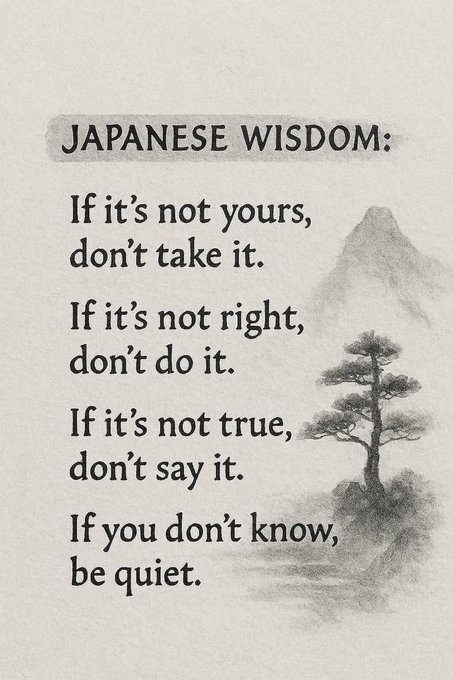
In the hustle of everyday life, where decisions come at us from all directions, there’s profound value in pausing to reflect on simple, timeless principles. Japanese wisdom offers a straightforward guide that can anchor us amid uncertainty: If it’s not yours, don’t take it. If it’s not right, don’t do it. If it’s not true, don’t say it. If you don’t know, be quiet. These four lines encapsulate a philosophy of restraint, honesty, and mindfulness that has roots in traditions like Zen and Bushido, emphasizing harmony with oneself and others.
Consider the first principle: “If it’s not yours, don’t take it.” This isn’t just about physical possessions; it extends to ideas, credit, or even emotional space. In professional settings, it means respecting intellectual property and giving due acknowledgment. Personally, it encourages us to avoid envy or overreaching, fostering contentment with what we have. By practicing this, we build trust in our relationships and avoid the complications that arise from entitlement or theft, whether literal or metaphorical.
Moving to “If it’s not right, don’t do it,” this calls for ethical discernment. Righteousness here isn’t about rigid rules but an internal compass that aligns actions with our values. For instance, in a world full of shortcuts, choosing integrity over convenience— like turning down a dubious opportunity—can lead to long-term fulfillment. Stories from Japanese folklore, such as samurai tales, illustrate how honoring what’s right builds character and resilience, much like a tree weathering storms through deep roots.
The third tenet, “If it’s not true, don’t say it,” combats the spread of misinformation and gossip. In an era of instant communication, words carry weight, and falsehoods can erode reputations or sow discord. Practicing this means verifying facts before sharing and choosing silence over speculation. It promotes authenticity, allowing genuine connections to flourish without the noise of deceit.
Finally, “If you don’t know, be quiet.” This is perhaps the most challenging in a culture that values opinions. Admitting ignorance opens doors to learning, rather than filling voids with assumptions. It encourages active listening and humility, qualities that enhance personal growth and collaborative environments.
Integrating these principles into daily routines can transform how we navigate challenges. Start by reflecting on them during quiet moments, perhaps journaling about instances where they’ve applied. Over time, this wisdom cultivates a life of peace, where actions are deliberate and words are meaningful, leading to deeper self-awareness and stronger bonds with those around us.