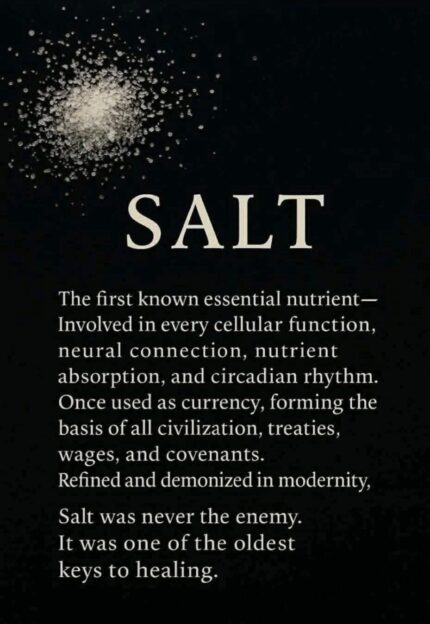
The evocative image centered on the word “SALT” accompanied by insightful text highlights the often-overlooked significance of this essential nutrient, inviting us to reconsider its rich history and vital role in human life. Described as the first known essential nutrient—integral to every cellular function, neural connection, nutrient absorption, and the regulation of our circadian rhythm—salt has a legacy that transcends its current reputation as a simple kitchen staple or a dietary concern.
Once a cornerstone of civilization, salt was revered and utilized in multifaceted ways, serving as currency that facilitated trade, forming the basis of treaties, wages, and covenants that shaped societies. Its value was so profound that it was often more precious than gold, underpinning the economic and cultural frameworks of ancient cultures. Yet, in modernity, salt has been refined, processed, and demonized, leading to widespread misconceptions about its role and benefits. The text boldly asserts that salt was never the enemy but one of the oldest keys to healing, challenging us to look beyond contemporary biases.
This perspective encourages a reevaluation of salt’s value, particularly in its natural, unrefined form. Rather than vilifying it as a health hazard, we can explore its benefits when used mindfully, appreciating its historical significance and potential contributions to health and vitality. Scientific insights support that salt, in moderation, supports essential bodily functions, while its historical use in preservation and healing practices underscores its enduring utility. Embracing this knowledge can lead to a more balanced approach to nutrition, fostering a deeper respect for nature’s gifts and encouraging a return to traditional wisdom. By understanding and honoring salt’s timeless value, we can integrate it thoughtfully into our lives, enhancing both our physical health and our connection to the past.